SMU's Fall 2025 Numbers: What The Surge Actually Means, And What It Doesn't
SMU's Fall 2025 applications jumped 56%, but the admit rate didn't hit a new low, it corrected after two unusually easy years. Here's what SMU's own data says about yield, test-optional trends, and Early Decision that the surface numbers don't show.
College Admissions Data
SMU's Fall 2025 Numbers: What The Surge Actually Means, And What It Doesn't
Joseph Green | Green College Admissions
Every fall, new SMU admissions numbers circulate on Instagram, Reddit, and parent group chats, sometimes accurate, often a year or two stale by the time they reach the families trying to plan around them. Here is what is actually true for the Fall 2025 cycle, straight from SMU's own University Decision Support office, its Common Data Set filings, and its admissions office at smu.edu, along with the parts of the story a single headline stat leaves out.
The Numbers
The Surge Didn't Make SMU Harder To Get Into. It Undid Two Easy Years.
SMU received 24,053 applications for Fall 2025, a 56% jump from the 15,245 applications it received the year before, the largest single-year increase in at least a decade. The admit rate for Fall 2025 landed at 47.6%, with 11,459 of those applicants admitted and 1,715 enrolling. On its own, that 47.6% figure reads like a school suddenly tightening up. It is not quite that simple. In the two years right before the surge, Fall 2023 and Fall 2024, SMU's admit rate ran unusually high, 61.2% and 63.3%, well above the roughly 47% to 53% range SMU held for most of the previous decade. Fall 2025's 47.6% is not a new low, it is close to where SMU sat for most of the 2010s, before two unusually generous admission cycles. The real story is not "SMU got much harder to get into overnight." It is a decade of steady demand, two loose years, and a record application spike all landing in the same cycle.
Then vs Now
2015: 12,992 applied, 6,360 admitted (49.0%), 1,374 enrolled. 2025: 24,053 applied, 11,459 admitted (47.6%), 1,715 enrolled. Over ten years, SMU's applicant pool nearly doubled while its admit rate ended up almost exactly where it started, according to SMU's University Decision Support office.
The Part Nobody Posts
SMU Is Winning Stronger Students, and Losing More of Them
Yield, the share of admitted students who actually enroll, has been sliding at SMU for a decade, and not slightly. In 2015, about 1 in 5 admitted students chose SMU, a 21.6% yield. By 2025, it was closer to 1 in 7, a 15.0% yield. That decline happened even as the students who did enroll got noticeably stronger academically: among students who submitted scores, the average ACT climbed from 29.4 in 2015 to 32.1 in 2025, and the average SAT rose from 1,309 to 1,410 over the same period, straight from SMU's own institutional data. Put those two facts together and the honest read is this: SMU is attracting a more academically impressive applicant pool than it used to, but it is also competing harder to close those students once it admits them, most likely because more of them have comparable offers sitting on the table elsewhere.
Worth A Caveat
Because SMU is test-optional, the students behind that rising ACT and SAT average are a shrinking, self-selected group, not the whole incoming class. Which is the next number worth knowing.
Test-Optional, By The Numbers
Almost Nobody Submits a Test Score at SMU Anymore
In 2015, 931 of SMU's 1,374 enrolled students submitted an ACT score (68%) and 647 submitted an SAT score (47%), the two overlap since some students submitted both. By Fall 2025, out of 1,715 enrolled students, only 148 submitted an ACT score (8.6%) and only 161 submitted an SAT score (9.4%), according to SMU's own admissions data. That is a genuine collapse in test submission, not a gradual decline. The practical read for applicants: the overwhelming majority of SMU's current class did not submit a test score at all, and the rising average scores reported each year reflect only the small, self-selected slice of applicants who chose to submit, not a rising bar for the whole incoming class.
The Essay
The "Optional" Essay Questions Aren't Really Optional If You Want An Edge
Every SMU applicant must submit the standard Common App personal essay. Beyond that, SMU offers two of its own supplemental questions, one asking why SMU is a good fit for you, the other asking how your background will shape the SMU community, and both are technically optional. SMU does not publish what share of applicants actually answer them, so treat any specific number you see elsewhere with skepticism. What is straightforward to say: in a cycle where applications jumped 56% in a single year, an optional response that most applicants are likely to skip is one of the few remaining ways to signal genuine interest and give an admissions reader something specific to remember. Skipping it will not disqualify anyone. It also will not help a student stand out in a noticeably larger applicant pool.
Early Decision
The 80.3% Number Isn't Free
SMU's Early Decision admit rate sits at 80.3%, compared to 47.6% overall, according to SMU's Common Data Set. That gap is real, but it is not a pure selectivity advantage. Early Decision is binding and self-selecting: the pool applying ED is disproportionately made up of students who are certain SMU is their first choice, often with stronger fit and more developed applications, not a random cross-section of all applicants. The higher admit rate partly reflects a stronger, more committed pool applying, not simply an easier bar to clear.
If Cox Is The Goal
What SMU Actually Publishes About Cox, and What It Doesn't
Cox is consistently the most requested business school inside SMU, so it is worth being precise about what SMU's own website actually says. Cox publishes its expected class size directly: about 100 B.B.A. Scholars and 575 Business Direct students per class, roughly 675 seats total. What SMU does not publish anywhere on smu.edu is a Cox-specific acceptance rate or a historical admissions trend. Any "Cox got easier" or "Cox got harder" statistic circulating online is coming from a third-party ranking site, not from SMU or a Common Data Set filing, and should be treated with the same caution as any unsourced statistic on the internet.
This Cycle
Key Dates For Fall 2027 Applicants
Straight from SMU's Office of Undergraduate Admission:
Application Options
Common App, ApplyTexas, or Coalition with SCOIR, SMU accepts all three with no preference between them. There is no application fee.
Deadlines
Early Decision I and Early Action: November 1, 2026. Early Decision II and Regular Decision: January 15, 2027.
Green College Admissions
Not sure how any of this affects your student's specific situation?
That is exactly what a consult is for. Serving DFW families in person and students across Texas and nationwide virtually.
What Texas A&M's Latest Numbers Actually Tell You About Applying
Applications are up, the admit rate is down, and most of what's circulating online is a cycle out of date. Here's what Texas A&M's admissions office, ABPA, and Common Data Set actually say right now.
College Admissions Data
What Texas A&M's Latest Numbers Actually Tell You About Applying
Joseph Green | Green College Admissions
Every year, a new batch of Texas A&M admissions numbers gets passed around Facebook groups, Reddit threads, and Instagram comment sections, usually a cycle or two out of date by the time they circulate. Here is what is actually true right now, straight from admissions.tamu.edu , the university's institutional data office (ABPA), and its Common Data Set filing, along with a few things about how admission really works that most of those recycled posts leave out entirely.
The Numbers
The Numbers Behind the Surge
Texas A&M received 89,422 applications for Fall 2025, according to the university's Academic and Business Performance Analytics office. That is up from 66,346 in 2021, a 34% increase in five years. Over that same window, the admit rate has fallen steadily, from 59.4% in 2021 to 51.3% in 2025. Of the students admitted, 20,725 enrolled, a 45.2% yield rate. Put simply, more students are applying every year, and the university is not growing its class size to match. That combination is the actual story behind "A&M is getting more competitive," not any single scary statistic on its own.
Once You're In
Once You're In, You're Staying
This is a number that almost never makes it into these roundups. Getting in and belonging once you are there are two different questions, and the data below answers the second one.
Retention and Graduation
According to Texas A&M's most recent Common Data Set filing, 94.3% of students who entered as first-time freshmen in Fall 2023 were still enrolled a year later. Six-year graduation rates sit at 84%, and roughly 61% of students graduate in four years or less. A&M's admissions process is genuinely more selective than it was five years ago, but students who make it in tend to stay and finish at rates most universities would envy.
The Part Families Miss
Getting Into A&M Isn't the Same as Getting Into Your Major
Some Top 10% students assume automatic admission settles everything. It does not. Automatic admission guarantees a spot at the university. It does not guarantee a spot in your first-choice major. Texas A&M's own admissions office spells this out directly for one college in particular: every applicant to the College of Engineering, including students who qualify for Top 10% automatic admission, is placed into General Engineering first, not directly into a specific major like Mechanical or Computer Science. Students move into their intended major later, through a separate internal process, based on academic performance once they are already enrolled. The takeaway for any family targeting a competitive college at A&M: do not treat "I'm Top 10%, I'm fine" as the end of the planning conversation. University admission and major admission are two different gates.
The Essay
The Essay Isn't What Most Students Think It Is
A lot of students assume they can recycle their Common App personal statement for every school on their list. Texas A&M does not work that way. Whether you apply through Common App or ApplyTexas, A&M replaces the standard essay entirely with its own required prompt: "Tell us your story. What unique opportunities or challenges have you experienced throughout your high school career that have shaped who you are today?" up to 750 words. Your Common App personal statement is not read, even if you submit it alongside your application. If you want the full breakdown, Part 1 covers the main essay in depth, and Part 2 walks through the five supplemental prompts, both worth a read before you start drafting.
This Cycle
Key Dates for This Cycle
For students applying for Fall 2027 admission to the College Station campus, straight from Texas A&M's Office of Admissions:
Application Window
Application opens August 1, 2026. The application deadline is December 1, 2026. A $75 application fee applies.
Document Deadline
All required documents, including your STARS record (Texas A&M's self-reported transcript system, where you enter your coursework and grades directly), are due December 15, 2026.
Test Scores
Texas A&M remains test-optional. SAT and ACT scores are never required, and submitting them will never work against you if you choose to send them.
Common App or ApplyTexas
The application platform you choose does not affect your admission decision either way. Choose whichever one you are already using for your other schools and keep your effort focused on the essay and your STARS record instead.
Green College Admissions
Not sure how any of this affects your student's specific situation?
That is exactly what a consult is for. Serving DFW families in person and students across Texas and nationwide virtually.
UT Austin Admissions: Myths vs. Reality
UT Austin families, here are 5 things the admissions website says directly that most people never read. From Early Action to demonstrated interest to supplemental essays, these facts come straight from admissions.utexas.edu.
Myths vs. Reality
5 Things Families Misunderstand Regarding UT Austin Admissions
By Joseph Green | June 28, 2026
Every year, families across Texas and beyond invest significant time preparing for the UT Austin application and still walk in with assumptions that simply are not accurate. Most of the time, these misunderstandings are not the family's fault. The information is out there, but it is buried, scattered, or contradicted by well-meaning people who are also guessing. This post pulls directly from admissions.utexas.edu to set the record straight on five of the most common myths, plus several additional facts that do not get nearly enough attention.
Myth 01
"A 4.0 and top 5% guarantees my child their desired major."
The Reality
Top 5% guarantees admission to UT Austin as a university. It does not guarantee placement into your child's first-choice college or major. McCombs, CNS, Cockrell School of Engineering -- these are separate decisions made through holistic review. UT Austin says explicitly that no class rank, test score, or single factor by itself ensures admission to a specific program. Getting in and getting your major are two entirely different outcomes. For a full breakdown of what holistic review actually considers at UT, read this.
Myth 02
"Applying Early Action improves my child's chances."
The Reality
UT Austin states this directly on their website: the Early Action deadline does not provide an advantage in the review process, nor is it binding. Applying by October 15 earns your child an earlier decision date -- nothing more. The review process is identical regardless of when the application is submitted. Families who stress about hitting EA believing it helps their chances are redirecting energy that belongs in the application itself.
Myth 03
"The Common App personal statement is all you need."
The Reality
Beyond the personal statement, UT Austin requires two supplemental short answer essays. The first asks why your child is interested in their first-choice major. The second asks which activity they are most proud of and why. Both are required to submit the application. These are not optional, and they are not the Common App essay. Students who treat these as an afterthought are missing one of the most direct opportunities to speak to the admissions office about who they are and what they want to study. For more on how UT evaluates supplemental writing, read this.
Myth 04
"Sending SAT or ACT scores from multiple test dates helps."
The Reality
UT Austin does not superscore the SAT or ACT. They use the highest composite score from a single test date. This is a critical distinction for families planning a multi-sitting test strategy. If your child has a 1420 from one date and a 1390 from another, UT sees the 1420 -- not a combined best-section total. Knowing this before your child begins testing changes how you approach the schedule entirely.
Myth 05
"Campus visits and emails to admissions help your child's chances."
The Reality
UT Austin does not consider demonstrated interest in the holistic review process. Campus tours, emails to admissions counselors, attending virtual info sessions, opening their marketing emails -- none of it factors into the decision. This is not true at every school, which is why families often assume it applies everywhere. At UT, it does not. Redirect that energy into the application itself, specifically the essays and short answers where your child actually has a voice.
Additional Insights
What else families should know
The five myths above made it into the reel. The following facts did not, but they are equally important for families navigating this process.
No Interviews
UT Austin does not conduct admissions interviews for general freshman admission. Families who expect an interview component -- particularly those familiar with private university processes -- should know that the written application is the only direct communication channel your child has with the admissions office.
Resume Is Optional
The resume is optional for freshman applicants. UT recommends submitting one if your child feels the activities section of the application did not provide a full picture of their involvement. If submitted, it should include work experience, extracurriculars, accomplishments, awards, and family responsibilities. There is no preferred format or length requirement.
No Separate Scholarship Application
There is no separate scholarship application at UT Austin. All freshman applicants who apply for admission and complete the FAFSA or TASFA are automatically considered for aid through the Texas Advance Commitment program. Families who spend time searching for a standalone scholarship portal are looking for something that does not exist.
Appeals Are Not Accepted
If your child is denied admission, UT Austin will not reconsider the decision through an appeal. Admission decision appeals or requests for additional reviews are not accepted. The only option for denied applicants is the waitlist, which is unranked and does not guarantee reconsideration. Knowing this in advance underscores why the initial application must be as strong as possible.
Letters of Recommendation
Letters of recommendation are optional at UT Austin, with a maximum of two. If submitted, UT encourages recommenders from outside the high school. They are looking for information that expands on what is already in the application, specifically around academic potential, leadership, persistence, cultural engagement, and preparation for the intended major. A letter that simply restates the transcript adds little. One that reveals something the application cannot is worth submitting.
The bottom line
Knowing what UT Austin is actually looking for, and what it is not, gives your child a meaningful advantage before the application opens. Common App opens August 1. If your child is applying to UT this fall, the time to understand the process is now, not after the deadline passes.
Green College Admissions
Serving DFW families in person and students across Texas virtually.
Independent college admissions consulting focused on fit, authentic storytelling, and understanding exactly what each school is looking for.
The Five Supplemental Essays: What A&M Is Really Asking
Texas A&M asks five supplemental essays alongside the main prompt. Most students underestimate them. Here is what each one is actually asking, and how to answer it well.
Texas A&M 2026-27
The Five Supplemental Essays: What A&M Is Really Asking
Joseph Green | June 24, 2026
Part 2 of 2
If you read Part 1 of this series , you already know how to approach the main Texas A&M essay, the 750-word prompt that anchors your entire application. This post is about the other five: short, focused, easy to underestimate.
Each supplemental prompt has a specific job. A&M is not asking five random questions. Together, Prompts 2 through 6 build a coherent picture of who you are, where you are going, why this field matters to you, why A&M is the right place to pursue it, and whether you are thinking past the degree. If those five essays all tell the same story, and if that story is consistent with your main essay, your application holds together in a way that reviewers remember.
Here is what I tell my students about each one.
Prompt 2 | 250 Words
"Describe a life event which you feel has prepared you to be successful in college."
Start in the middle of it.
At 250 words, you have no room for setup. The students who write the weakest versions of this essay spend their first 80 words explaining the context before anything happens. Do not do that. Open where the pressure is highest. Drop the reader into the moment before you explain anything.
The event you choose matters, but not in the way most students think. It does not need to be dramatic. It needs to be specific, and it needs to mirror something you will actually face at A&M. If you plan to study engineering, choose something that required you to solve a hard problem under pressure. If you are going into business, find the moment you had to make a real decision without all the information you needed. The parallel should be obvious to the reader by the time you are done.
End with two things: the lesson you took from the event, and brief, concrete proof that you have already applied it. Not "I learned to persevere." Tell me about the next time you hit something hard and what you did differently because of this experience.
One sentence per idea. Every sentence earns its place. At 250 words, anything that does not move the essay forward is a sentence you cannot afford.
Prompt 3 | 100 Words
"In a few words, what are some of your life goals and objectives?"
Generic goals hurt you here.
"I want to make a difference." "I hope to use my degree to help others." "I want to be a leader in my field." These are the answers that show up in thousands of applications, and they tell an admissions reader nothing. Vague aspirations are not goals. They are placeholder language.
The goals in this prompt should be ones that only you would have. There are two ways I see students write this well. The first is to start from deep personal motivation: something you have been working toward or thinking about for years, then paint a specific picture of the impact you want to have. The second is to put yourself 15 to 20 years out and describe your actual life. Not your job title. Your life. What problems are you working on? What does your day look like? Who are you helping?
Either approach works. What does not work is staying so high-level that no reader can picture you. Include at least one goal that is personal, and at least one that is outward-facing. Show range.
Prompt 4 | 100 Words
"In a few words, why have you chosen your academic major(s)?"
Write a love letter, not a resume line.
Origin stories take too long at 100 words. Do not start with when you first got interested. Start with what you are interested in right now.
The best versions of this prompt lead with a specific question or problem in the field that genuinely occupies the student's mind. Not "I've always loved math." Something more like: "There is a question in structural engineering that I cannot stop thinking about," and then they tell me what that question is. I want to feel the pull.
Think of this as a love letter to a subject. When you write a love letter, you do not list reasons. You describe what makes the other person irreplaceable. A&M should read this and believe, without any doubt, that this is your favorite thing to think about. Not a smart career decision. Not a practical choice. The thing you would explore even if no one paid you to.
If you find yourself writing about job prospects or salary potential, start over. That is Prompt 3 territory at best. This prompt is about intellectual love, and it should read that way.
Prompt 5 | 100 Words
"We know you have a lot of options. In a few words, why did you choose to apply to Texas A&M?"
"Aggie spirit" is not an answer.
Neither is "great engineering program" or "strong reputation." A&M knows it has a strong reputation. That is not news. Generic praise signals that A&M is on your list. It does not signal that A&M is your choice.
This prompt rewards specificity. Name one or two things you actually found when you looked into A&M. A specific lab. A faculty member's research. A program or certificate track that is offered at A&M and almost nowhere else. A campus organization that connects directly to something in your activities list. Then spend a sentence explaining why it connects to who you are, not just what you want to study.
The goal is to make A&M feel chosen. There is a real difference between an essay that says "A&M is a great fit for me" and one that says "I have been watching Dr. [Name]'s work on [specific topic] since junior year, and there is no other undergraduate program where I can be in that room." One of those reads like a student filling out a form. The other reads like someone who has done their homework and knows exactly where they want to be.
Do that research. It takes two hours and it changes the entire feel of your application.
Prompt 6 | 100 Words
"Briefly describe any educational plans you have beyond earning your bachelor's degree."
Let it follow from Prompt 4.
If you have written Prompt 4 well, Prompt 6 should feel like the natural next chapter. You wrote about a question or problem in your field that genuinely drives you. Prompt 6 asks: where does that curiosity take you after the degree?
This is not a commitment. You are not signing a contract. A&M wants to see that you are a learner by nature, that your education does not end at graduation because that is just how you are wired. The students who write this well name specific questions they want to keep exploring, whether through graduate school, research, industry practice, or some combination. They do not just say "I plan to pursue a master's degree." They say what they hope to do with it.
If you genuinely are not sure whether you want grad school, that is fine. Write about the questions you want to keep close. That signals the same thing: intellectual curiosity that does not expire.
The Bigger Picture
All five supplementals should tell one story alongside your main essay.
Prompt 2 shows you handle adversity and grow from it. Prompt 3 shows you know where you are going and why. Prompt 4 shows you have a subject that genuinely drives you. Prompt 5 shows that A&M is a deliberate choice. Prompt 6 shows you are thinking past the degree.
When all five work together, and when they reinforce rather than repeat the main essay, the reader gets a complete, coherent picture of a student. That is the goal. Not five good essays. One good application.
A note on word counts
The 100-word prompts are not invitations to be vague. They are invitations to be precise. Every word is doing real work or it is not there. Read each short essay aloud. If a sentence does not add something new, cut it. The best 100-word essays I have seen read like they could not be shorter without losing something essential. That is the bar.
The 250-word prompt for Prompt 2 gives you more room, but not much. Do not treat it like a mini-essay with an introduction, body, and conclusion. Treat it like a scene with a lesson attached. Scene, then insight, then proof. That is the structure.
Work With Joe
Your essays should sound like you.
I help students find that voice.
Green College Admissions serves DFW families in person and students across Texas and nationwide virtually. If you want a real conversation about your A&M application, reach out below.
greencollegeadmissions.comThe A&M Main Essay 2026-27: What Admissions Wants From Future Aggies
Texas A&M just released their 2026-27 essay prompts. Here's what admissions actually wants from future Aggies — and why the main essay is not what most students think it is.
Texas A&M · 2026-27 Essay Prompts
The A&M Main Essay 2026-27: What Admissions Wants From Future Aggies
Knowing what they want changes everything.
By Joseph Green | Green College Admissions | June 23, 2026
Green College Admissions works with students across Texas and nationwide to build thoughtful, strategic applications. Texas A&M just released its 2026-27 required essays, and if you are a rising senior with A&M on your list, this is the moment to get clear on what they are actually asking.
This post focuses on Prompt 1: the main essay at 750 words. It is the most important piece of writing on your A&M application, and it is the one most students get wrong.
The Prompt
750 words
"Tell us your story. What unique opportunities or challenges have you experienced throughout your high school career that have shaped who you are today?"
That is 100 words longer than the Common App personal statement. It is also a completely different assignment. The two prompts may look similar on the surface, but they are asking for something meaningfully distinct.
This Is Not Your Common App Essay
The Common App personal statement asks who you are. The A&M main essay asks who you are right now , at the end of high school, shaped by what you lived through. Because that is the person who will walk onto campus in College Station.
A&M is not asking for your origin story. They are not asking for a timeline from freshman year to now. They are asking for evidence of the person you have become. The distinction matters enormously when you sit down to write.
"The question underneath the prompt is: Who will you be here?"
Every word of your essay should attempt to answer that question. Not narrate the path that got you there. Answer it.
The #1 Mistake
Most students copy-paste their Common App essay and change nothing.
Different word count. Different prompt. Different purpose. A&M admissions readers review thousands of applications. A recycled essay reads like one. It wastes the best real estate on the entire application: the one place you have the most space to show who you actually are.
What To Do Instead
Start with who you are right now. Then show how you got there.
Most students write backward. They open at freshman year and narrate forward as if the essay is a timeline. The reader ends up waiting the entire essay to meet the actual person. By the time they arrive, the word count is up.
The stronger approach leads with the person, then uses high school experience as evidence. Your challenges and opportunities are not the story. They are the material that built the story.
A Structure That Works
1 Hook
Drop the reader into a specific moment. Make them feel present before you explain anything.
2 Thesis
The single point you want the reader to walk away with. Everything else argues for it.
3 Before / After
Show the transformation, not just the event. The reader should see the contrast clearly.
4 Who you are now
Land the reader in the present. Your values, your orientation, your readiness. This is who shows up on campus.
The Count: 750 Words
Seven hundred and fifty words sounds like a lot. It is not.
A thin essay, one that coasts at 500 words or fills space with vague generalizations, signals a student who did not take the question seriously. Use every word. Every sentence should be earning its place by revealing something about who you are. A&M gave you 750 words because they want to know you. Take the invitation seriously.
The Bottom Line
The A&M main essay is your single best opportunity to show admissions who you are beyond your transcript. It is not a formality. It is not a longer version of your Common App essay. It is a deliberate opportunity to make a case for yourself as a future Aggie.
Students who approach it that way stand out. Students who recycle their Common App essay do not.
Joseph Green
Joseph Green is an independent college admissions consultant and founder of Green College Admissions , based in Keller, TX. He works with students across the DFW area and nationwide, specializing in the narrative and strategic layer of competitive applications.
UT Austin Holistic Admissions: What Happens After the Auto-Admit List
75% of UT Austin's freshman class is filled by class rank. The other 25% is decided by something else entirely. Here's what holistic review actually looks at.
Green College Admissions | Insights
UT Austin Holistic Admissions: What Happens After the Auto-Admit List
By Joseph Green | June 18, 2026
At Green College Admissions , one of the most common things I hear from Texas families is some version of this: "My child isn't in the top 5%, so UT Austin is off the table." That belief is understandable. It's also incomplete.
State law requires UT Austin to fill 75% of its in-state freshman seats through automatic admission based on class rank. For fall 2026 applicants, that threshold is the top 5%. But that leaves 25% of every incoming class admitted through a different process entirely: holistic review. That 25% does not go to students with the highest stats who just missed the cutoff. It goes to students who make a compelling case across the full picture of their application.
This post breaks down exactly what that process looks at, and what it means practically for a student who is not auto-admit.
The 25% nobody talks about
Under Texas Education Code, UT Austin is legally required to automatically admit any Texas resident who graduates in the top percentage of their high school class, up to 75% of the in-state enrollment cap. Once that 75% is filled, the remaining seats, plus all out-of-state and transfer applicants, go through holistic review.
That is not a small number. For a flagship university that enrolled around 8,600 freshmen in a recent class, 25% represents well over 2,000 seats filled based on something other than rank alone. Those students are not statistical outliers who snuck through. They are admitted because their applications made a case that reviewers found compelling.
The question is: what does that case look like?
What UT Austin's admissions officers actually consider
UT Austin publishes its holistic review criteria directly on its admissions website. The factors are:
Class rank and strength of academic background
Rank still matters in holistic review, but it is weighed in context. A student ranked 12th in a class of 500 at a rigorous high school is read differently than the same rank at a different school. Course rigor sits alongside rank in this evaluation.
Test scores
UT Austin is test-required. Scores are part of the file, but they are one input among many. There is no published cutoff. A strong score helps; a lower score does not automatically disqualify a holistic applicant if the rest of the application is cohesive.
Achievements, honors, and awards
Formal recognition matters, but it does not have to come from a national competition. Reviewers are looking for evidence of initiative and accomplishment in the context of what was available to that student.
Work, service, and extracurricular activities
The quantity of activities is less important than the pattern they reveal. A student who has held a part-time job and mentored younger students in one area tells a cleaner story than a student with fifteen unconnected clubs.
Personal essays
For holistic applicants, essays are often the most important part of the file. This is where a student can provide context a transcript cannot, explain choices, and make a reviewer feel like they understand who this person is and why they belong at UT Austin.
Recommendations
UT Austin does not require recommendations, but accepts them. A strong letter from a teacher who can speak specifically to a student's intellectual curiosity or growth adds a dimension a GPA cannot.
Fit to your chosen major
This is the factor that comes up most consistently among holistic admits. UT Austin reviews applications at the college and major level. A student applying to Computer Science who has spent three years building software projects tells a coherent story. A student applying to the same program whose activities have no connection to it does not.
Source: admissions.utexas.edu
Your rank is one input. Your story is another.
The families I work with who feel locked out of UT Austin because of rank are often looking at the wrong variable. Holistic review does not ask whether a student can survive at UT Austin. It asks whether this student belongs in this college, in this major, right now.
That is a question a rank cannot answer. It is a question essays, activities, and deliberate framing can answer very well.
"Holistic review does not ask whether a student can survive at UT Austin. It asks whether this student belongs in this college, in this major, right now."
The practical implication: if your child is not in the top 5%, the work is not to manufacture credentials they don't have. The work is to build an application that tells a coherent story about who they are and what they intend to study. That starts earlier than most families think, and it requires more than a strong personal statement drafted the summer before senior year.
If UT Austin is on your child's list and they are not auto-admit, the question is not whether to apply. The question is whether the application they submit tells that story clearly enough to compete.
Related reading
Beyond the Numbers: Holistic Admissions at UT Austin and Texas A&M
Should You Submit a Test Score to Michigan? Here's What the Data Shows.
Is UT Austin on your child's list?
I work with Texas families to build the application layer that holistic review is actually looking for. Essays, activities framing, school list strategy, and major fit. If your child is a junior or rising senior, now is the right time to start.
Get in TouchJoseph Green
Independent college admissions consultant based in Keller, TX. Founder of Green College Admissions . 25 years in education. Serving Texas families in person and students nationwide virtually.
What Admissions Officers Actually See
Your child's GPA and test score open the door. Here's what admissions officers are actually evaluating on the other side of it.
What Admissions Officers Actually See
Your child's transcript starts the conversation. Their application has to finish it.
Think of every college application as an iceberg. What most families spend all their time on sits above the waterline. The part that decides the outcome is below it.
It's a fair question. And the answer isn't that grades and scores don't matter. They do. They're the price of admission to the conversation. But at most competitive colleges, the conversation doesn't end there.
Here's what's actually happening on the other side of the application.
The iceberg model
Think of every application as an iceberg. The tip, GPA, course rigor, test scores, is what gets your child's file picked up. Every applicant in a competitive pool has something there. It's the floor, not the ceiling.
Below the waterline is where the actual decision happens. That's where admissions officers spend most of their time, reading essays, reviewing activities, weighing recommendations, and asking whether this student's application speaks to this school in a way that feels specific, not generic.
The families who understand this early are the ones who spend junior year building that layer, not cramming for another practice test. For a deeper look at how one test-optional school weighs scores, see our breakdown of whether to submit a test score to Michigan .
"A compelling story from a 1280 will outperform a flat application from a 1400. Every time."
The three questions every reader asks
When an admissions officer reads your child's application, they're trying to answer three things:
The subjective layer: what actually moves the needle
Below the waterline, these are the components that determine outcomes in close decisions:
This applies everywhere, not just test-optional schools
One thing families often assume is that if a school reinstated test requirements, scores must be driving the decision. That's not how it works. Schools like Harvard, Georgetown, Cornell, and UT Austin all require scores, and all read every essay, weigh every recommendation, and evaluate whether each applicant's story fits the school they're applying to.
A test score gets your child's file opened. It doesn't get them in. That's true whether the school is test-optional or test-required, whether the acceptance rate is single digits or fifty percent.
The application layer is where this gets decided. And that layer takes time to build.
"The work starts now. Not in August."
If your child is a junior and hasn't started thinking about their story, their essays, or their activities narrative, this is the moment to start.
Test-Optional at A&M. Here's What the Data Shows.
Texas A&M is test-optional. But 79% of enrolled freshmen submitted SAT scores. Here's what that means for your child's application strategy.
Test-Optional at A&M.
Here's What the Data Shows.
Most families assume test-optional means scores don't matter. The numbers tell a different story, and understanding them is the first step toward a smarter application strategy.
Texas A&M University is test-optional. No SAT or ACT score is required for freshman applicants. That's official policy, confirmed on the admissions.tamu.edu website. But if your family is using that fact as the foundation of your A&M strategy, you may be missing something important.
At Green College Admissions , I work with families across the DFW area and nationwide who are navigating the college application process. One of the most common misconceptions I see is the belief that test-optional means scores are irrelevant. At A&M, the data suggests otherwise.
What the Enrollment Data Actually Shows
According to the Texas A&M Common Data Set 2024-2025 and IPEDS, 79% of enrolled freshmen submitted SAT scores . Another 21% submitted ACT scores. That means the vast majority of students who enrolled at A&M chose to send a score, even though they weren't required to.
CDS 2024-2025 / IPEDS
This doesn't mean your child is penalized for not submitting. A&M's policy is clear: no score is required, and the university states test scores are "considered" when submitted, not required. But the pool your child is competing against looked very different from what many families expect.
Score Ranges of Enrolled Students
Among the students who did submit scores, here is where they landed. These are middle 50% ranges, meaning 25% of students scored below the lower number and 25% scored above the higher number.
| Test | 25th Percentile | 75th Percentile | Source |
|---|---|---|---|
| SAT Composite | 1161 | 1383 | ABPA Fall 2024 |
| ACT Composite | 25 | 32 | ABPA Fall 2024 |
Source: Texas A&M Academic and Business Performance Analytics (ABPA), Fall 2024 enrolled first-time full-time students.
These are benchmarks worth knowing. If your child's score falls comfortably within or above this range, submitting it is likely a net positive. If it falls below, that's not disqualifying, but it does shift the weight onto the rest of the application.
"Test-optional doesn't mean scores are unimportant. It means the rest of your application has to carry more weight when you don't submit one."
What A&M Actually Weighs
The CDS Section C7 tells you what Texas A&M considers "very important" in its admissions decisions. Three factors sit at the top: rigor of coursework, class rank, and academic GPA. Test scores are listed as "considered," which places them below these three criteria in the official framework.
| Factor | A&M Weight |
|---|---|
| Rigor of coursework | Very Important |
| Class rank | Very Important |
| Academic GPA | Very Important |
| Standardized test scores | Considered |
Source: Texas A&M Common Data Set 2024-2025, Section C7.
This is where the strategy conversation gets important. For students in the top 10% of their Texas high school class, A&M offers automatic admission. But for everyone else, the application is evaluated holistically, and that evaluation extends well beyond the score question.
The Score Decision Is Just the Beginning
Whether your child submits a score or not, the rest of the application still needs to be built carefully. Essays, activities, demonstrated interest, and the overall story your child tells, these are the elements that differentiate applications in a pool of over 89,000 applicants with a 51% admit rate that continues to tighten.
89,422 applicants. 45,866 admitted. 20,725 enrolled. Admit rate: 51.3%. A school this size, with this many applicants, is not a safety for most students. Source: ABPA Fall 2025.
Most families I work with are surprised when they see these numbers. A&M has grown significantly in competitiveness. The families who navigate it well are the ones who understand both the data and the full application picture, and who build a strategy around both.
If your family is beginning to think through an A&M application and you want to understand what a strong application actually looks like beyond the score decision, that's the conversation I specialize in. You can learn more or reach out through the link below.
Green College Admissions · Keller, TX
Should Your Child Submit a Standardized Test Score to Michigan?
Michigan went test-optional in 2024. Here's what the published score ranges actually mean, what they leave out, and how to make the right submission decision for your child.
Should Your Child Submit a Standardized Test Score to Michigan?
Michigan went test-optional in 2024. Only half of applicants submitted scores. Here is what the data actually means and how to make a decision that helps, not hurts.
At Green College Admissions, we work with families navigating exactly these decisions. After operating under a test-flexible policy since 2020, the University of Michigan formally adopted a permanent test-optional policy in February 2024, effective for students entering Winter 2025 and beyond. For the first full cycle under that policy, just over half of applicants chose to submit a standardized test score. That number, 51%, tells you something important, but probably not what you think it does.
This post is not a list of score cutoffs. Michigan does not publish cutoffs, and anyone who gives you a single number and calls it a threshold is overstating what the data can actually tell you. What this post does instead is explain what the published score ranges mean, what they leave out, and how to think about the submission decision in a way that actually helps your child's application.
Sources: U-M Office of Budget and Planning First-Year Class Profile, Fall 2024 and 2025; 2024-25 Common Data Set.
What the Published Numbers Show
Michigan's Office of Budget and Planning publishes a detailed first-year class profile each fall. For the Fall 2024 enrolled class, here is what the score data shows for students who chose to submit:
| Test | Middle 50% Range | Submission Rate |
|---|---|---|
| SAT Total | 1360 to 1530 | 51% of enrolled class |
| ACT Composite | 31 to 34 | 18% of enrolled class |
| GPA | 3.9 to 4.0 | Average enrolled student |
Source: U-M First-Year Class Profile, Fall 2024 enrolled class, obp.umich.edu. Score ranges reflect enrolled students who submitted scores only.
At first glance, these numbers look like a benchmark. A 1360 SAT or a 31 ACT is the 25th percentile floor for submitted scores. That is useful context. But reading those numbers as a submission threshold misses something critical about how this data was generated.
What the Numbers Do Not Show
The published score ranges reflect enrolled students who chose to submit. Students who submitted strong scores but enrolled elsewhere are not in this data. Neither are admitted students who chose not to submit scores at all.
That distinction matters enormously. The 51% of enrolled students who submitted scores were a self-selected group. High scorers are more likely to submit their scores, because submitting a strong score is a rational application decision. The result is that the published middle 50% range skews upward relative to the full admitted class.
Layer on top of that: students who scored above 1530 and were admitted to Michigan but chose to enroll at a different school are also absent from this data. Michigan's published ranges describe a very specific population: students who applied, were admitted, chose to enroll, and chose to submit scores. That is not the same as the full picture of who Michigan admits, and it is certainly not a complete picture of who gets in.
- Enrolled submitters only. The ranges reflect students who submitted a score and chose Michigan. Students admitted with strong scores who enrolled at peer schools are not in this data.
- Self-selected pool. High scorers are more likely to submit. The full admitted class includes non-submitters whose scores are invisible in Michigan's published data.
- Context, not a cutoff. Michigan publishes no score threshold. These numbers describe who showed up, not who got in, and not what your child should do.
What Michigan Actually Says About Test Scores
Michigan's test-optional policy is genuine, not performative. The university rates standardized test scores as "Important" in its Common Data Set, one tier below GPA and course rigor, which are rated "Very Important." Students who do not submit scores will not be penalized. Michigan's admissions office has stated that applications are reviewed holistically regardless of whether a score is present.
That said, Michigan is not test-blind. Submitted scores are considered in context. A strong score from a student at a school with limited AP offerings reads differently than the same score from a student at a highly resourced school with a full slate of rigorous courses. Admissions officers are trained to evaluate numbers in context, and that context includes everything else in your child's file. If you want to go deeper on how holistic review works at Texas's flagship schools, our post on holistic admissions strategy at UT Austin and Texas A&M covers the same framework in detail.
How to Actually Think About This Decision
Rather than anchoring to a specific number, there are three questions worth working through before your child decides whether to submit:
Does the score help tell the story?
A strong score confirms something the rest of the application already suggests: that your child can handle rigorous academic work at a competitive university. If the score is consistent with the academic record, it reinforces the narrative. If it is significantly below the rest of the profile, it may raise questions the application does not answer.
Is the score within range of enrolled submitters?
At or above 1360 SAT or 31 ACT, your child's score is within the range of students who submitted and enrolled. Below that, the score is below the 25th percentile of a self-selected pool of already-strong submitters. That does not mean it hurts automatically, but it shifts the calculus. A score well below the range adds less than the absence of a score in most cases.
What does the rest of the application look like?
Test-optional works best when the application has something else to carry it. For a deeper look at what that means in practice, see our post on building a competitive test-optional application. Exceptional essays, meaningful activities, demonstrated impact, and strong teacher recommendations are what fill the space a score might otherwise occupy. If those elements are strong, the absence of a score is less consequential. If those elements are thin, submitting a competitive score provides a useful data point for the reader.
The Bottom Line
Michigan's published score ranges are a starting point, not a verdict. They reflect a narrow slice of the applicant pool, filtered three times over, and they do not capture the full range of students Michigan admits each year. A student with a 1320 who does not submit scores is not disqualified. A student with a 1400 who submits is not guaranteed anything.
What the data does tell you is this: Michigan is a 16% school with 109,000 applicants and a genuinely holistic review process. Every piece of the application matters. The score decision is one part of a larger strategy, and it deserves more thought than a single number can provide.
Beyond the Numbers: How UT Austin and Texas A&M Actually Evaluate Your Application
For students outside the auto-admit threshold at UT Austin and Texas A&M, the holistic parts of the application aren't optional. Here's what they are and why they matter.
If your child is applying to UT Austin or Texas A&M, GPA and class rank are probably at the center of your planning. They should be. But for a large portion of Texas applicants, those numbers are only part of the story. Once a student falls outside the automatic admission threshold, the application becomes something different entirely. It becomes a holistic review, and that is where strategy makes the difference.
The Auto-Admit Threshold: A Floor, Not a Plan
Both schools operate under Texas's automatic admission law, but the cutoffs are not the same.
UT Austin automatically admits Texas residents who graduate in the top 5% of their high school class. That cutoff has tightened in recent cycles as application volume has surged. UT received over 90,000 freshman applications for fall 2025. The number of seats has not kept pace. Here's a deeper look at what UT's acceptance rate actually means for Texas families.
Texas A&M automatically admits Texas residents in the top 10% of their graduating class. The university's headline acceptance rate is approximately 51%, but that figure is shaped significantly by auto-admits and does not reflect what the process looks like for students going through holistic review. For out-of-state applicants, there is no automatic path at all. If your family is applying from outside Texas, this post covers what OOS families actually need to know about A&M admissions.
For students just outside either cutoff, strong numbers still matter. But they are no longer enough on their own. That is where the holistic parts of the application take over.
What Holistic Review Actually Means
Your numbers get you noticed. Your story gets you in.
When admissions officers at UT or A&M move into holistic review, they are reading the full application. GPA and test scores are already in the file. What they are looking for now is the person behind those numbers. Four components carry the most weight in that evaluation.
The Cost of a Numbers-Only Application
A student with a strong GPA and competitive test scores who submits a numbers-heavy application with no compelling narrative is one of the most common patterns behind students who end up with CAP at UT or an outright denial at A&M. It is not that their numbers were wrong. It is that the holistic parts of the application did not do any work.
CAP postpones admission to UT's main campus for one year. It is not a rejection, but it is not what a student who earned a 4.0 and a competitive SAT planned on when they applied. And it is often avoidable with the right approach. The holistic parts of the application are not optional. For students outside the auto-admit threshold, they are the deciding factor.
How Green College Admissions Can Help
This is exactly the work we do at Green College Admissions. We work with students and families on the parts of the application that numbers alone can't represent: the personal statement, supplemental responses, activities section, and honors. The goal is an application that tells a coherent, authentic story, one that makes your child memorable to an admissions officer who has read thousands of files just like theirs.
We serve DFW families in person and students nationwide virtually. If UT Austin or Texas A&M is on your child's list and they are a junior or senior, now is the right time to be strategic about it.
Let's build the story.
Independent college admissions consulting for families who want more than a checklist. Serving DFW in person and students nationwide virtually.
View our services →What Out-of-State Families Need to Know Before Applying to UT Austin
Texas law reserves 90% of UT Austin's freshman class for Texas residents, and automatic admission fills roughly 75% of the class before holistic review begins. Here is what that means for out-of-state families.
What Out-of-State Families Need to Know Before Applying to UT Austin
The published acceptance rate is 26.6%. That number is real. It is also misleading for families outside of Texas.
Every year, families across the country set their sights on The University of Texas at Austin. It is a flagship institution with a strong national reputation, programs that rank among the best in the country, and an acceptance rate that, on the surface, looks reasonable. At 26.6% for the Class of 2028, UT Austin appears to be a selective but attainable reach school for a strong out-of-state applicant.
That reading is incomplete. And for out-of-state families, the gap between the published number and the actual competitive landscape is significant enough to change how you approach the application entirely.
Texas Law Sets the Table Before Holistic Review Even Begins
Texas Education Code Section 51.803 requires that at least 90% of UT Austin's enrolled freshman class be Texas residents. This is not a preference or a policy that admissions officers apply with discretion. It is state law, and it governs the composition of every incoming class.
Within that Texas-resident pool, automatic admission fills approximately 75% of the freshman class before a single application is reviewed holistically. Under House Bill 3041, Texas residents who graduate in the top 5% of their high school class receive guaranteed admission. This threshold applies to Fall 2026 admits and beyond.
Out-of-state applicants compete for what remains after both of those priorities are satisfied. The 26.6% overall acceptance rate does not reflect that reality.
UT Austin does not publish a specific out-of-state acceptance rate, and third-party calculations vary enough that citing a single figure would be misleading. What the structural facts make clear, without any additional calculation, is that out-of-state applicants are competing for a meaningfully smaller share of the class than the headline number suggests.
There Is No Automatic Path for Out-of-State Applicants
The auto-admit pathway is exclusively available to Texas residents. Regardless of class rank, GPA, or test scores, every out-of-state application goes through individualized holistic review. A student graduating first in their class from an out-of-state high school receives the same process as every other non-Texas applicant. There are no exceptions.
This matters because many families approach UT Austin the way they approach other flagship schools, assuming that exceptional academic credentials create a kind of threshold above which admission becomes likely. At UT Austin, for out-of-state applicants, that assumption does not hold. Strong credentials are necessary but not sufficient. The process is genuinely holistic, and every element of the application carries weight.
What Holistic Review Actually Considers
For out-of-state applicants, the following factors shape the decision:
- Essays carry significant weight. Two are required, one is optional via the Common App. For out-of-state applicants without the built-in advantage of residency, the essays are often where the case for admission is made or lost.
- SAT/ACT scores are required. UT Austin is not test-optional. This is a meaningful distinction from many peer institutions, and families should plan accordingly.
- Rigor of coursework, class rank, and grades all factor into the review.
- A resume and letters of recommendation are optional, but submitting strong supporting materials is worth the effort.
No admissions interviews. UT Austin does not offer interviews for undergraduate admission. There is no opportunity to make a personal impression outside of the written application.
Demonstrated interest is not considered. Visiting campus, attending information sessions, and emailing admissions officers are common strategies at schools that track demonstrated interest. UT Austin explicitly does not consider it. Those efforts will not improve your child's chances.
What this means practically: everything that determines admission must live in the application itself. The essays, the transcript, the test scores, and the supporting materials are the entire record. There are no supplementary signals, no soft factors to compensate for a weaker area, and no relationship to build with admissions over time.
Your Child Is Applying to a College, Not Just a University
At UT Austin, admission decisions are made at the level of the specific college and major your child applies to, not at the university level. This distinction matters more than most families realize when they are building their strategy.
Two programs draw particularly heavy out-of-state interest and carry the highest degree of selectivity: the McCombs School of Business and the Cockrell School of Engineering. Both are nationally ranked programs, both attract a large volume of competitive out-of-state applications, and both carry differential tuition on top of the already-higher non-resident base rate. Out-of-state students admitted to McCombs or Cockrell pay more than out-of-state students in other colleges within UT Austin.
Choosing one of these programs without understanding how that choice affects the competitive landscape is one of the most common strategic mistakes out-of-state families make. Applying to a high-demand major with a strong but not exceptional profile, when a lower-demand program might have been a better fit, is a pattern that costs students admission every cycle.
The Cost Reality Most Families Are Not Prepared For
Even for families who have thought carefully about cost, the gap between in-state and out-of-state expenses at UT Austin is larger than most expect when the full cost of attendance is calculated over four years.
| In-State | Out-of-State | |
|---|---|---|
| Tuition & Fees | $11,688/yr | $44,908/yr |
| Annual COA (on campus) | ~$32,446/yr | ~$65,666/yr |
| Four-Year COA | ~$129,784 | ~$262,664 |
Source: UT Austin Texas One Stop, 2024-2025 published rates / onestop.utexas.edu
There is an additional variable that families rarely factor in at the planning stage: the Texas legislature's resident tuition freeze applies through 2026-2027, but it does not apply to non-resident students. Out-of-state tuition at UT Austin has increased approximately 5% year over year in recent cycles. The figures shown reflect 2024-2025 published rates. The actual four-year gap for a student enrolling today is likely higher than $132,880.
For families applying to McCombs or Cockrell, both programs also carry a differential tuition charge of $1,100 per semester on top of the standard non-resident rate. That adds approximately $8,800 over four years on top of the premium already shown above.
What This Means for Your Strategy
None of this is an argument against applying to UT Austin. For the right student with the right profile, the right program fit, and a clear-eyed understanding of the financial picture, it can absolutely make sense. What it is an argument against is applying to UT Austin the way you would apply to a school where the published acceptance rate tells the whole story.
Out-of-state applicants who do well at UT Austin tend to share a few things in common. They apply to a program where their profile is genuinely competitive at that college's selectivity level, not just at the university level. Their essays are strong enough to carry real weight in a holistic review where there is no automatic path and no supplementary relationship to lean on. And their families understood the financial picture before the application was submitted, not after an acceptance arrived.
The OOS strategy at UT Austin is different. Building it before you apply is the only way to do it right.
Sports vs. College Prep: Where Should Your Investment Go?
83% of sports parents believe their child will play in college. Only 2% receive an athletic scholarship. Here's what the data says about where your investment should actually go.
Sports vs. College Prep:
Where Should Your Investment Go?
If you have a child playing travel baseball, club soccer, or competitive lacrosse, you already know what it costs. Equipment, team fees, tournament registrations, hotel rooms, flights. For many families, the annual investment runs from $3,000 to $10,000 or more. And most of the time, that investment is made with one eye on college.
The hope is straightforward: if my kid is good enough, sports opens the door. A scholarship, a roster spot, a path forward. It is a reasonable hope. But the data tells a more complicated story, and most families do not see it until it is too late to adjust.
The Gap Between Belief and Reality
According to a New York Life survey, 83% of parents with children in youth sports believe their child has what it takes to compete at the college level. Nearly half believe a scholarship is a realistic outcome. These are not unreasonable parents. They are watching their kids work hard every day, and they believe in them.
But the NCAA tells a different story. Fewer than 7% of high school athletes go on to compete at any college level. Only 2% of all high school athletes receive any form of athletic scholarship. And the sports where families spend the most, baseball, soccer, lacrosse, are among the least funded when it comes to college scholarships.
The gap between what parents believe and what the data shows is not a failure of love. It is a failure of information.
The Numbers by Sport
Not all sports carry the same odds. Here is what the data shows for the most commonly played youth sports in the US, based on NCAA participation reports:
| Sport | High School Athletes | % Who Play in College |
|---|---|---|
| Lacrosse | ~200,000 | 12.8% |
| Baseball | ~490,000 | 7.5% |
| Football | ~1,000,000 | 7.3% |
| Soccer | ~830,000 | 5.6% |
| Basketball | ~540,000 | 3.5% |
Lacrosse has the highest rate of any common sport at 12.8%. That sounds encouraging until you consider that lacrosse is also one of the least-funded sports in college athletics. Most lacrosse programs offer little to no scholarship money. Baseball and soccer follow the same pattern: higher-than-average participation rates at the college level, but minimal financial aid attached to those roster spots.
Football and basketball are where the scholarship money concentrates. But they are also where the competition is most intense and the odds of earning a meaningful scholarship are lowest of all.
What the Sport Cannot Do
Here is what most families do not fully reckon with: even if your child earns a college roster spot, that moment is the outcome of the sport. It is not the beginning of a career, and for the overwhelming majority of student athletes, it is not a financial windfall either.
The college application, on the other hand, is not a single moment. It is the result of four years of intentional work. Grades, course rigor, extracurricular depth, leadership experiences, community involvement, and an essay that articulates who your student actually is. That story does not write itself in senior year. It is built, year by year, starting in 9th grade.
Families who begin positioning their student in 9th and 10th grade arrive at the application with a story to tell. Families who wait until junior or senior year are scrambling to fill gaps that cannot be filled in time.
It Is Not Either/Or. It Is About Priority.
This is not an argument against youth sports. Sports teach discipline, resilience, and teamwork in ways that genuinely matter. Many of the qualities that make a strong college applicant are developed on a field or in a gym.
But there is a difference between supporting your child's athletic development and betting your college strategy on a roster spot that the data suggests is unlikely to materialize. The families who navigate this well are the ones who invest in both, while being clear-eyed about which one has a guaranteed outcome.
A completed, well-positioned college application is a guaranteed deliverable. A college scholarship is not. That distinction matters when you are deciding where your time, energy, and money should go during the high school years.
Where to Go From Here
If your student is in high school right now, the most valuable question you can ask is not "is my child good enough to play in college?" It is "are we building the kind of profile that gives my student the best possible outcome, regardless of what happens with sports?"
That question has a clear answer. And it starts now, not senior year.
Texas A&M Out-of-State Admissions: What OOS Families Actually Need to Know
Out-of-state applicants to Texas A&M play by completely different rules than Texas residents. No auto-admit path. A four-year cost premium of nearly $108,800. A tuition freeze that doesn't apply to them. And a scholarship waiver most OOS families never find. Here is what the admissions page actually says.
Texas A&M Out-of-State Admissions: What OOS Families Actually Need to Know
No auto-admit path. Holistic review only. A cost premium that compounds. And a scholarship waiver most families never find.
The overall acceptance rate at Texas A&M is 51.3%. If your child is applying from out of state, that number tells you almost nothing about their actual situation.
Out-of-state applicants at Texas A&M play by a completely different set of rules than Texas residents. No automatic admission path. A cost structure that differs by more than $100,000 over four years. A tuition freeze that applies to residents but not to them. And a scholarship waiver pathway that most OOS families never find because nobody tells them to look for it.
This post covers everything that matters if your child is applying to Texas A&M from outside of Texas.
The Two-Path Problem
Texas law gives students in the top 10% of their graduating class automatic admission to any Texas public university. For high-achieving Texas residents, this means the admissions question is largely answered before the application is submitted.
Out-of-state applicants do not qualify for this pathway. Regardless of class rank, GPA, or course rigor, every OOS application is reviewed holistically. There are no exceptions.
Every out-of-state application to Texas A&M is reviewed holistically, no exceptions, regardless of class rank or GPA.
This distinction matters because it changes the entire strategic approach. An OOS applicant cannot plan around automatic admission. They have to build an application that earns a seat through holistic review, and that process starts well before senior year.
Source: admissions.tamu.edu/resources/future-students/out-of-state
What Holistic Review Actually Looks At
Texas A&M evaluates OOS applicants across two categories. Both matter. Neither can be ignored.
- All high school courses attempted and grades earned
- Rigor of coursework
- GPA and class rank
- Extracurricular activities
- Community service and leadership
- Employment and summer activities
- Extraordinary opportunities, challenges, and hardships
The academic record is the foundation. Rigor matters as much as GPA. A strong grade in an easy course reads differently than the same grade in AP or IB coursework. The non-academic factors give context to who the student is outside of the classroom.
Source: admissions.tamu.edu/apply/freshman
The Engineering Wrinkle OOS Families Miss
If your child wants to study engineering, there is an additional layer to understand.
Even Texas residents who qualify for automatic admission are not admitted directly to the College of Engineering. They are reviewed for placement into General Engineering, a gateway program, not admitted into the college itself. OOS applicants to Engineering go through the same holistic review process as every other OOS applicant.
There is no separate path and no shortcut, even for top students. The holistic review process applies in full. Engineering-bound OOS applicants should plan their application with that reality at the center, not as an afterthought.
Source: admissions.tamu.edu/apply/freshman
The Cost Reality
The financial gap between in-state and out-of-state attendance at Texas A&M is significant. Understanding it is not optional for OOS families planning around affordability.
There is one additional factor that widens this gap over time. The Texas legislature tuition freeze applies to resident students through the 2026–2027 academic year. Non-resident students are on a variable-rate tuition plan. The freeze does not apply to them, which means OOS tuition can increase year over year while resident tuition stays fixed.
Source: TAMU Student Business Services 2025–2026, sbs.tamu.edu
The Scholarship Path Most OOS Families Never Find
This is the most important financial fact in this entire post.
OOS students who earn a competitive academic scholarship from Texas A&M may be able to waive the additional costs of non-resident tuition and fees entirely.
Texas A&M offers competitive academic scholarships that are available to both in-state and out-of-state students. When an OOS student earns one of these scholarships, they may qualify to have the non-resident premium waived, bringing their cost of attendance significantly closer to the in-state rate.
This does not happen automatically. It requires the right application strategy, and that strategy needs to be built long before the application window opens.
December 1 is both the application deadline and the cutoff for scholarship consideration at Texas A&M. For OOS families, that date carries extra weight. Missing it does not just mean a late application. It means losing access to the scholarship pathway entirely.
Source: admissions.tamu.edu/resources/future-students/out-of-state
What This Means for Your Application Strategy
The OOS path at Texas A&M requires a different approach from the beginning, not adjustments made in the fall of senior year.
Holistic review means the academic record, the course rigor, the extracurricular depth, and the written application all need to work together. Scholarship positioning means the application has to be strong enough to earn a competitive academic award, not just earn admission. And the December 1 deadline means the entire strategy needs to be operational well before most families start thinking about applications.
The families who navigate this well do it early. The ones who don't are usually the ones who found out too late that the 51.3% acceptance rate was never their number to begin with.
If Texas A&M is on your child's list, the time to build the right approach is now.
UT Dallas vs. Purdue vs. Carnegie Mellon: Is the Out-of-State Premium Worth It?
UT Dallas costs $136,800 over four years. Purdue costs $180,000. Carnegie Mellon costs $348,000. Before your family commits to the out-of-state premium, here are the numbers and the five questions that actually matter.
UT Dallas, Purdue,
or Carnegie Mellon:
How to Think About
the Out-of-State Premium
Every spring, DFW families face a version of the same conversation. The acceptance letters have arrived. The financial aid packages are in. And somewhere on the kitchen table is a decision that looks, on the surface, like a simple choice between a school you recognize and a school you know well. It is not a simple choice.
I have spent 25 years in education and the last several working directly with DFW families on exactly these decisions. The question I hear most often comes down to this: is the out-of-state school worth the extra money?
For families with students in STEM, business, and engineering, three schools come up together more than almost any other combination right now. UT Dallas. Purdue. Carnegie Mellon. Each one represents a different point on the cost spectrum. Each one has a legitimate case to make. And most families are making this decision without the data they actually need.
This post is an attempt to fix that.
The Cost Ladder, Honestly
Before we talk about rankings or employers or outcomes, let's get the numbers on the table. These are sticker-price cost of attendance figures — tuition, fees, housing, food, books, and living expenses — for the 2024-2025 academic year, drawn directly from each institution's primary published sources.
That is a $43,000 four-year premium for Purdue over UTD. And a $211,000 four-year premium for Carnegie Mellon over UTD. Sit with those numbers for a moment before we move on. Families routinely make this decision without ever writing those figures down side by side.
What the Purdue Premium Actually Buys
Purdue is a genuinely excellent engineering school. That is not a qualifier — it is the starting point for an honest conversation.
In the US News Best Colleges 2026 rankings, Purdue's College of Engineering ranked 8th nationally among doctorate-granting universities. Nine of its eleven engineering programs placed in the top ten in their specific disciplines. Industrial engineering ranked 2nd. Aerospace and astronautical engineering ranked 3rd. Civil engineering ranked 3rd. These are programs that compete with MIT, Stanford, and Georgia Tech for the same students.
US News 2026
College Scorecard
The recruiting pipeline reflects that standing. Purdue graduates go to Boeing, Lockheed Martin, Caterpillar, John Deere, Raytheon, and a long list of major defense, aerospace, and manufacturing employers who have been recruiting from West Lafayette for decades. If your child wants to build aircraft, design propulsion systems, or work in industrial engineering at a global manufacturer, Purdue's network is a real and meaningful asset.
The $43,000 four-year premium is real. So is the question of whether your child needs to leave Texas to access what Purdue offers.
For some students and some programs, yes. For others, no. That answer depends on what your child wants to study, which specific employers they want to work for, and whether those employers recruit meaningfully at both schools — or primarily at one.
What the Carnegie Mellon Premium Actually Buys
Carnegie Mellon is in a different category entirely, and the price reflects it.
CMU ranked 2nd nationally in undergraduate engineering in the US News 2026 rankings. Its computer science program is consistently ranked among the top two or three in the country. Its robotics institute is the largest of its kind in the world. Its ECE program feeds Google, Apple, Microsoft, Amazon, and virtually every major technology employer in the country.
US News 2026
College Scorecard
The $211,000 four-year sticker premium over UTD is real. But here is what most families do not know before they start this process: Carnegie Mellon meets 100 percent of demonstrated financial need for all US citizens and permanent residents. Families earning under $75,000 annually attend tuition-free. Families earning under $100,000 have their full demonstrated need covered without loans.
The sticker price at CMU is genuinely irrelevant for a large portion of families. The question is what CMU costs your family specifically. Run the net price calculator before you make any assumptions.
If your family's net price at CMU comes out to $40,000 per year after institutional aid, you are looking at a $160,000 four-year total — still more than UTD, but a very different conversation than $348,000.
What UT Dallas Actually Delivers
This is where I want to spend some time, because UTD gets undersold in these conversations.
UT Dallas ranked 77th nationally in undergraduate engineering in the US News 2026 rankings, 49th among public universities, and 3rd among public universities in Texas behind only UT Austin and Texas A&M. The Erik Jonsson School of Engineering and Computer Science is a legitimate research institution — UT Dallas holds R1 Carnegie Classification status, shared by fewer than 150 institutions in the country.
3rd public in Texas
in Texas (Forbes)
College Scorecard
Forbes named UT Dallas the number one best-value public university in Texas. The average net price after grants and scholarships is $16,094 per year. For families who qualify for the Comet Promise program — household income at or below $100,000 — tuition is fully covered through a combination of institutional funding, scholarships, and grants.
The employer network deserves more attention than it typically gets. UT Dallas sits in the middle of a technology and corporate corridor that includes Texas Instruments, AT&T, Ericsson, Cisco, Samsung Austin Semiconductor, Lockheed Martin, L3Harris, Toyota North America, and multiple Goldman Sachs DFW operations. Eighty-three percent of UTD's student body are Texas residents. These employers are not recruiting at UTD because it is convenient. They are recruiting at UTD because it produces graduates who know the regional market, understand the business environment, and are ready to work.
The DFW employer network is a feature of choosing UT Dallas, not a consolation prize for staying in Texas.
The Earnings Math
Here is a simple way to think about the earnings gap versus the cost gap.
The Purdue math is simpler. The four-year sticker premium over UTD is $43,200. The median earnings differential is approximately $4,400 per year. That premium pays back in roughly ten years — not a great return if financed with significant loans, but a reasonable calculation if your family can absorb the cost without debt.
None of this is advice to choose one school over another. It is a framework for making the decision with your eyes open.
Five Questions to Answer First
I work through these with every family I advise when an out-of-state school is on the table. They do not produce a single right answer. They produce the right answer for your child.
The overall engineering ranking is one data point, but your child is not enrolling in the overall engineering program. They are enrolling in mechanical engineering, or electrical engineering, or computer science. Look at the discipline-specific rankings before you make assumptions from the headline number.
Every school's financial aid page has a net price calculator. Run it. The sticker price gap between UTD and CMU is $211,000. The net price gap for your family may be significantly smaller — or, in some cases, nearly nonexistent.
Purdue's pipeline into aerospace and manufacturing is real and deep. But if your child wants to work in DFW's technology corridor, or in finance, or in healthcare administration, the question is whether Purdue's network is actually stronger for that goal than UTD's.
The College Scorecard gives you institution-wide median earnings. It is an imperfect but defensible starting point. Run the basic math: how many years of the earnings differential does it take to recover the cost differential? Is that timeline reasonable given your family's financial situation?
This is the hardest question to answer honestly, because prestige is real and it does carry weight in certain industries and hiring environments. But it is worth asking directly: is your family choosing this school because the data supports it, or because the name feels safer?
No Universal Right Answer
A student who wants to design jet engines and has a clear path into aerospace recruiting at Purdue may be making an excellent decision at $180,000. A student who earns significant need-based aid at Carnegie Mellon and wants to work in AI or robotics may be making an even better one. And a student who earns a UTD engineering degree, graduates with minimal debt, and enters the DFW technology market at 22 years old with zero loan payments may be making the smartest financial decision of all three.
What matters is that your family has the information to make the call deliberately — not based on rankings alone, not based on name recognition, and not based on what feels right in April when the acceptance letters are on the table.
These decisions start earlier than most families realize. The school list, the financial strategy, and the application approach are all connected. By the time the letters arrive, the decisions that shaped them are already behind you.
If your child graduates in 2027, 2028, 2029, or 2030, there is still time to get this right.
UTD Common Data Set 2024-2025 (oisds.utdallas.edu) / Purdue Office of the Bursar 2024-2025 (purdue.edu/treasurer) / Carnegie Mellon Student Financial Services 2024-2025 (cmu.edu/sfs) / US News Best Colleges 2026 / US Department of Education College Scorecard / Forbes Best Value Colleges 2023 / UTD Office of Admission and Enrollment (enroll.utdallas.edu)
This is the right time to start the conversation.
25 years in education. Independent. Experienced.
Keller-based, serving DFW families in person and students nationwide virtually.
A Strong College Application Is Not Built in August of Senior Year
What the current UT Austin and Texas A&M acceptance rates mean for DFW families with students in 9th, 10th, and 11th grade, and why the families who get where they want to go start the conversation earlier than most.
A Strong College Application Is Not Built in August of Senior Year
What the current UT Austin and Texas A&M acceptance rates mean for DFW families with students in 9th, 10th, and 11th grade, and why the families who get where they want to go start the conversation earlier than most.
Every spring, DFW families with high school juniors start searching the same two questions: what is the UT Austin acceptance rate, and what is the Texas A&M acceptance rate. They are looking for reassurance, or at least a realistic picture of what their child is up against. The numbers they find, depending on where they look, are often out of date or pulled from the wrong source.
Here are the current figures, pulled directly from the official institutional dashboards.
UT Austin: IRRIS Interactive Common Data Set 2024-25, reports.utexas.edu | Texas A&M: ABPA Applied/Admitted/Enrolled Dashboard, Fall 2025, abpa.tamu.edu
Those are not the numbers from when an older sibling applied. The applicant pool at both schools has grown significantly over the past several years, and the doors have narrowed accordingly. Families who are planning based on older data are working with an outdated map.
But the numbers themselves are not the point of this post. The point is what they mean for a DFW family with a student who is finishing 9th, 10th, or 11th grade right now.
The Common App Does Not Start the Process. It Closes It.
There is a common assumption among DFW families that the college application process begins in the summer before senior year, when the Common App opens on August 1. That assumption is understandable. The Common App is the most visible part of the process. It is where everything gets submitted.
But the application is not built in August. It is built over the three years that come before it.
The students who submit strong applications to UT Austin and Texas A&M in the fall of their senior year did not start strong in August. They accumulated the experiences, interests, and context that make a compelling application over the preceding three years. By the time the Common App opens, the students who are positioned well are already ready. The application is a record of who they became, not a performance they put together at the last minute.
This is not an argument for anxiety. It is an argument for timing. If your child is finishing one of those earlier years right now, their window is open.
Every Applicant Has Strong Scores. That Is Not What Gets You In.
At a 26.6% acceptance rate, UT Austin is rejecting nearly three out of four applicants. The students who are not admitted are not failing students. They are accomplished students with strong transcripts and competitive test scores who were not differentiated in the committee room.
Admissions officers do not admit transcripts. They admit people. The students who are accepted at competitive schools are the ones whose applications told a story no one else in the pool could tell.
That distinction matters for how a family thinks about preparation. The question is not just how to make a student look competitive on paper. It is how to help a student understand and articulate who they actually are, what they genuinely care about, and where they are going, in a way that is specific enough to be remembered.
- Demonstrated interest, shown consistently over time, not manufactured at the last minute
- A coherent narrative that connects who your child is to where they are going
- Depth in a few things, not volume across many
The students who submit the most effective applications are not the ones with the longest activity lists. They are the ones with the clearest sense of who they are and why it matters. That clarity takes time to develop. It also takes someone who knows the right questions to ask.
Most DFW Families Are Sitting on a Stronger Application Than They Realize.
One of the things I see consistently in my work with DFW families is that the material is almost always there. The student has experiences that did not feel significant at the time. Interests that never made it onto a resume. Context that explains the transcript in a way the grades alone cannot.
Most families do not know how to find those things, surface them, or shape them into something a college can understand and remember. That is not a criticism. It is simply not something families are equipped to do on their own, and it is not something a student can usually do for themselves.
That is the work. Not filling out forms. Not building a list of safety schools. Not writing a draft of the Common App essay in August. The work is helping a student understand their own story well enough to tell it to a stranger in a compelling way, and doing that before senior year leaves enough time to get it right.
This Is the Right Time to Start the Conversation.
Green College Admissions works with DFW families at every stage of the process. For families with students in the earlier high school years, the conversation is about building the right foundation, understanding what colleges are looking for, and helping a student develop the experiences and self-awareness that make a strong application possible.
For families with juniors, the conversation is more immediate. There is still time. But not unlimited time, and how the next several months are spent matters.
I am Keller-based and serve DFW families in person. I also work with students nationally through virtual consulting. The initial conversation is the right place to start.
Keller-based, serving DFW families in person.
UT Austin acceptance rate: IRRIS Interactive Common Data Set 2024-25, Section C1. reports.utexas.edu/common-data-set/interactive
Texas A&M acceptance rate: ABPA Applied, Admitted and Enrolled Dashboard, Fall 2025. abpa.tamu.edu/accountability-metrics/student-metrics/applied-admitted-enrolled
Cal Berkeley: Built for California. Brutal for Everyone.
California families assume Berkeley is their school. The data tells a more complicated story. Here's what the numbers actually say about in-state advantage, acceptance rates, and what it means for your list.
Cal Berkeley: Built for California.
Brutal for Everyone.
California families assume Berkeley is their school. The data tells a more complicated story.
Every year, California families put UC Berkeley near the top of the college list with a quiet confidence that other schools don't get. The assumption is understandable. Berkeley is a public university. It was built by California, funded by California, and designed to serve California students first. In-state tuition is a fraction of out-of-state. California residents make up the vast majority of the admitted class.
All of that is true. And none of it changes what the acceptance rate actually is.
2024-25
Received
Extended
Roughly 1 in every 9 applicants received an offer of admission. That is not a California number. That is not a residency number. That is the number for everyone who applied, and it applies regardless of where you grew up.
The California Advantage Is Real
To be clear: California residency matters at Berkeley. It matters structurally and it matters in the data. In the most recent admitted class, 79% of admitted first-year students were California residents. That figure comes directly from Berkeley's official August 2024 admissions release citing UCOP data.
Berkeley is, by design, a California institution. The state legislature funds it, the UC system prioritizes in-state enrollment, and the numbers reflect that mandate. A California applicant is competing in a larger and more favorable pool than an out-of-state student.
Californians own the lion's share of a very small room. The room is still very small.
But 79% of 14,502 is still only about 11,457 California admits. Against a backdrop of tens of thousands of California applicants, that number puts the advantage in perspective. Residency moves the odds in your favor. It does not move them to your favor.
A Decade of Decline
The most important context for any Berkeley conversation isn't today's acceptance rate. It's the direction the rate has been moving, and for how long.
| Year | Overall Acceptance Rate | Trend |
|---|---|---|
| 2017 | ~17.1% | |
| 2019 | ~16.3% | ↓ |
| 2021 | ~14.0% | ↓ |
| 2023 | ~11.3% | ↓ |
| 2025 | 11.43% | → |
| ~Estimated figures. Source: UC Berkeley CDS historical / UC Freshman Fall Admissions Summary via UCOP. 2025 figure from UC Berkeley CDS 2024-25 / opa.berkeley.edu Quick Facts. | ||
Applications to Berkeley surged approximately 51% between 2017 and today. The number of available seats did not grow at anything close to that rate. That math runs in one direction only, and it has been running that way for nearly a decade.
The rate appears to have stabilized around 11% for the past two cycles. That is not a recovery. That is the new floor, and families planning around a 15% or 17% Berkeley from a few years ago are working with outdated information.
If Berkeley is on your student's list as a "likely" or a fallback, that strategy needs to be revisited. An 11.43% overall acceptance rate means Berkeley belongs in the same planning tier as other highly selective universities, with the same level of application investment and the same expectation of a strong backup list.
The Numbers, Plainly
126,843 people applied to UC Berkeley in the most recent application cycle. 14,502 received offers of admission. That means 112,341 did not.
The majority of those 112,341 were California residents. Being from California narrowed the gap. It did not close it.
Did Not Get In
California Residents
Hard For Everyone. Including Californians.
Berkeley isn't a school that's hard for out-of-state students and manageable for everyone else. It's hard for everyone, including the Californians it was built to serve. The in-state advantage is real and it matters for how you build your college list. It does not change what kind of application Berkeley requires.
Being a Californian moves the needle. It does not move the mountain.
- Truth: California residents have a meaningful structural advantage at Berkeley. The admitted class is 79% California.
- Myth: That in-state advantage makes Berkeley accessible or likely for a typical California applicant. It does not.
- Reality: With an 11.43% overall rate and over 126,000 applicants, Berkeley requires the same quality of application as any other highly selective university.
- Implication: California families should plan their college list with Berkeley as a reach, support it with well-researched match and likely schools, and apply early where possible.
Building a list that includes Berkeley?
The data tells you what the odds are. Strategy determines what you do with them. Let's build a plan that's honest about Berkeley and strong enough to work without it.
Work With JoeVanderbilt's Acceptance Rate: What the Last Decade Actually Shows
Vanderbilt's acceptance rate was around 11% in 2014. For the Class of 2029, it fell to 4.7%. Here's what that means for families with Vanderbilt on their list.
Vanderbilt's Acceptance Rate Has Tightened Considerably.
What It Means for Families Applying Today.
The trend every serious applicant needs to understand.
If Vanderbilt is on your student's list, there is one number you need to update before you go any further.
The school's acceptance rate in 2014 was approximately 11 percent. For the Class of 2029, it fell to 4.7 percent overall. The regular decision rate alone dropped to 3.3 percent. And for the Class of 2030, the regular decision rate hit 2.8 percent, the lowest in Vanderbilt's history.
That is not a small shift. That is a fundamentally different school to get into.
What the Numbers Actually Show
Here is the full trajectory, drawn from Vanderbilt's official Common Data Sets and admissions releases. The decline is not a blip. It is a decade-long compression with no sign of reversing.
Source: Vanderbilt University Common Data Sets 2014-2025 and official admissions releases. Years marked "est." are estimated from aggregators citing the CDS; 2022 forward confirmed from official Vanderbilt data.
The story is not just the rate dropping. It is why it dropped.
Vanderbilt's entering class size has held at approximately 1,600 students for at least a decade, per the university's own Common Data Set. The number of available seats has not meaningfully changed. What has changed is the number of people competing for them.
~3,300 admitted
Class size: ~1,600
2,304 admitted
Class size: ~1,600
More applicants. Same seats. The math is unavoidable. Applications more than doubled from the 2014 cycle to the 2025 cycle. Every new applicant who joins the pool competes for the same roughly 1,600 spots.
Why So Many More Students Are Applying
Three forces are compounding at the same time, and none of them are going away.
What This Means for a Texas Family
A student with a 3.9 GPA and a 1450 SAT who looks at Vanderbilt as a "competitive reach" is not wrong. But "competitive reach" in 2025 means something very different than it did in 2014.
The RD acceptance rate now sits in the same range as schools families typically treat as Ivy-adjacent longshots. The more strategic path is Early Decision.
Recent Cycles
Class of 2030
Through ED
For a student who has done the financial work and knows Vanderbilt is their first choice, applying Early Decision is not just a preference; it is a strategic necessity.
The other thing Texas families need to understand is that Vanderbilt has no in-state preference. There is no automatic admissions pathway, no state mandate, no reciprocity agreement. Every Texas applicant is competing in the same pool as students from New York, California, Massachusetts, and 87 other countries. Eighty-five percent of Vanderbilt's entering class comes from out of state. Texas students are the out-of-state applicants here.
Texas families who have only ever navigated UT Austin or Texas A&M, both of which have structured in-state pathways, can underestimate how different a Vanderbilt application is. There is no auto-admit. There is no guaranteed second look. The application does all the work, or it does not work at all.
The Plan Has to Match the School
Vanderbilt is still an exceptional university. It meets 100 percent of demonstrated financial need with no loans in initial aid packages. Its residential college system creates an unusually strong campus community for a research university. The Peabody College of Education consistently ranks among the best in the country. The Blair School of Music is genuinely elite. None of that has changed.
What has changed is the standard of the application. The work ethic, the narrative, the specificity of fit required to stand out in a pool of 50,000-plus applicants, many of whom look very similar on paper to your student, is not the same conversation it was when you were in high school researching colleges.
If Vanderbilt is on the list, the planning conversation needs to happen earlier than most families think.
Ready to build a smarter application?
If your student has Vanderbilt on their list, now is the time to be strategic, not reactive. Let's build a plan that actually fits the data.
Schedule a ConsultationThe University of Michigan Acceptance Rate: What It Really Means for Out-of-State Students
Michigan's overall acceptance rate is 15.6%. But if your student isn't from Michigan, that number doesn't tell the whole story. Here's what the data actually shows.
The University of Michigan Acceptance Rate Is Not What You Think It Is
15.6% overall. But if you're not from Michigan, you're playing a different game entirely.
If you've been Googling "University of Michigan acceptance rate" and found a number somewhere around 15 to 16%, you now have half the story. The half that matters, especially if your student doesn't have a Michigan address, is something the university doesn't make easy to find.
Here's what the data actually says.
98,310 Applications. 15,373 Offers. You Do the Math.
For Fall 2024, the University of Michigan received 98,310 first-year applications and admitted 15,373 students.
Class of 2028 | Fall 2024
Fall 2024
1 offer per 6.4 apps
Source: University of Michigan Common Data Set 2024-25
That puts Michigan in the same conversation as Carnegie Mellon, Emory, and Georgetown. Five years ago, the acceptance rate was 26%. That's a 10-percentage-point collapse in half a decade, driven almost entirely by a surge in applications while admitted class size stayed relatively flat. Ten years ago, that same number was 32%.
The trend line doesn't reverse. Every family considering Michigan should be planning for a school that gets harder each year.
The Number Nobody Publishes
Here's where the story gets more complicated. Michigan is a public university with a legislative mandate to serve Michigan residents. That means its overall acceptance rate blends two pools that have dramatically different odds.
The university does not officially publish separate in-state and out-of-state acceptance rates, and has never confirmed a specific breakdown. What follows are figures commonly cited by third-party admissions analysts, not numbers released by Michigan. Treat them as directional context, not verified data:
Michigan enrolls approximately half its class from within Michigan. The pattern is consistent with what you'd expect from a flagship state university honoring a public mandate to serve state residents.
If your student is from Ohio, Texas, California, or anywhere outside the state, the 15.6% headline is probably too generous.
Out-of-state applicants at Michigan are competing in a pool that looks more like a highly selective private university than a state school. This is the gap that families often don't account for when they build a college list.
What Actually Gets You In
Michigan uses a holistic review process, meaning each application is read multiple times by multiple reviewers before a decision is made. The factors that matter, drawn from Michigan's official admissions page and Common Data Set:
| Factor | Weight |
|---|---|
| Course Rigor — the hardest schedule your school offers | Very Important |
| GPA — in context of your school's grading environment | Very Important |
| Essays — your voice, your story, your reasons for Michigan | Important |
| Recommendations | Important |
| Extracurricular Involvement — depth, leadership, community | Important |
| Test Scores — test-optional since 2024; submitted scores still reviewed in context | Important |
| Geography, Socioeconomic Context, First-Gen Status — underrepresented areas get explicit consideration | Considered |
| Legacy Status | Not Considered |
Source: admissions.umich.edu/apply/first-year-applicants/selection-process; UMich Common Data Set 2024-25
The CDS data on enrolled students reinforces the academic bar. Among enrolled first-year students in the 2024-25 cycle, the average GPA was 3.9, with roughly 39% holding a 4.0 or above and 54% landing between 3.75 and 3.99. For test-submitters in the Class of 2028, the mid-50% SAT range was 1360-1530 and the ACT range was 31-34.
Applications Have Tripled. Seats Haven't.
Here's what's driving that acceptance rate down year over year: the application pool is growing much faster than Michigan's freshman class.
Sources: UMich Common Data Set 2024-25 (Classes of 2024, 2025, 2028); The University Record, University of Michigan (Class of 2029 application volume)
Meanwhile, Michigan enrolls roughly 7,000 to 7,300 first-year students each year. The math is simple: more students chasing the same number of seats means a lower acceptance rate, even if the school doesn't change a single thing about how it evaluates applicants.
Part of what's driving that surge is national recognition. Forbes named the University of Michigan a "New Ivy" for 2025, citing its academic selectivity, employer appeal, and graduate outcomes. As the prestige landscape shifts away from traditional Ivy League schools, Michigan has emerged as one of the institutions employers increasingly prefer. That recognition brings attention, and attention brings applications.
Source: Forbes New Ivies 2025
The practical implication for a family outside Michigan: this is not a safety school. It's not even reliably a match school for most out-of-state applicants. It belongs on a college list that is built honestly around what the data shows, not what the brand feels like.
One More Thing to Know: Early Action
Michigan offers Early Action (non-binding) with a November 1 deadline and decisions by late January. Michigan does not publish EA vs. Regular Decision acceptance rates, so no official comparison exists. Independent analysts have observed that EA applicants tend to show higher acceptance rates, but Michigan itself states that applying EA does not confer a formal admissions advantage.
If Michigan is a genuine target, applying EA makes sense from a timing standpoint. It won't guarantee admission, but it gives you clarity earlier, and it signals genuine interest in a school that values demonstrated commitment.
What About the 2025-2026 Cycle?
Michigan's Class of 2029 cycle set an application record of 109,112, according to The University Record, University of Michigan's official news publication. The overall acceptance rate for that cycle is reported at 16.42%, a slight uptick driven by a larger admitted class alongside record application volume. The Common Data Set for 2025-2026, which will carry the official final figures, has not yet been published. When that data drops, this analysis will be updated. Check back at greencollegeadmissions.com/insights for the latest.
Source: The University Record, University of Michigan; UMich CDS 2025-26 pending
The Bottom Line for Families Outside Michigan
The University of Michigan is one of the strongest public universities in the country. For in-state students, it remains genuinely accessible, with third-party analysts commonly estimating in-state rates around 39%. For out-of-state students, those same third-party estimates put the rate around 18%, placing Michigan in the same competitive tier as many highly selective private universities, with out-of-state tuition to match.
If your student is serious about Michigan, the application needs to be built that way: course rigor maximized, essays written with specificity to Michigan's programs and community, and a college list that doesn't treat Ann Arbor as a fallback.
Ready to build a smarter application?
If your student has Michigan on their list, now is the time to be strategic, not reactive. Let's build a plan that actually fits the data.
Schedule a ConsultationJoe Green is an independent college admissions consultant and owner of Green College Admissions, based in Keller, TX. He works with students across the DFW area and nationwide to help them build thoughtful, strategic applications to competitive universities. Learn more at greencollegeadmissions.com.
UT Austin's Acceptance Rate: What 26.6% Actually Means for Your Texas Student
UT Austin's acceptance rate is 26.6%. But that number tells two very different stories depending on where your student is from. Here's what the data actually means for Texas families.
UT Austin's Acceptance Rate: What 26.6% Actually Means for Your Texas Student
If you've been watching UT Austin's acceptance rate drift lower year after year, you're not imagining it. For the Class of 2028 (Fall 2024 entry), UT received 72,885 freshman applications and admitted 19,417 students, landing at an overall acceptance rate of 26.6%. That's a real number from the official Common Data Set, and it deserves more than a headline. Here's what it actually means for a Texas family trying to plan.
26.6% Is an Average, Not Your Odds
The first thing to understand is that UT Austin's overall acceptance rate is a blended number. It includes in-state students, out-of-state students, auto-admits, holistic review admits, and everyone in between. When you blend those populations together, you get 26.6%. But your student isn't applying as a statistical average; they're applying as a specific kind of applicant.
In-state acceptance rate vs. out-of-state acceptance rate for the Class of 2028. Same school, two very different realities.
Texas residents fare significantly better than the headline suggests. The in-state acceptance rate for the Class of 2028 was approximately 41%, driven largely by the state's automatic admission policy. Out-of-state students, on the other hand, faced a far steeper climb, with an acceptance rate closer to 10%. Of roughly 23,000 out-of-state applicants, only about 2,332 were admitted. That gap is not a rounding error; it's state law in action.
Auto-Admit: The Floor, Not the Ceiling
Texas state law requires UT Austin to automatically admit any Texas resident who graduates in the top 5% of their high school class. It also requires that at least 90% of UT's freshman class come from Texas, with 75% of in-state seats reserved for those auto-admits. In practice, that means the majority of UT's incoming class is filled before holistic review even starts.
First, if your student is in the top 5%, they are guaranteed admission to UT Austin. What they are not guaranteed is their first-choice major. Auto-admit guarantees a seat on the Forty Acres; it does not guarantee a seat in Cockrell Engineering or McCombs Business. Major-specific competition is a separate, and often more difficult, conversation.
Second, if your student is just outside the top 5%, they move into holistic review, where they compete for a much smaller pool of remaining spots alongside out-of-state applicants who are often highly competitive nationally. The effective acceptance rate for that group is not 26.6%. It's considerably lower.
Applications Are Rising Faster Than Seats
Here's the trend that should concern every Texas family regardless of where their student stands: UT Austin received 90,562 freshman applications for Fall 2025, a 24.3% jump from the 72,885 applications received for Fall 2024. Out-of-state applications alone surged 48% in that single cycle. UT Austin has become a national destination school, not just a Texas flagship. Forbes named UT Austin a "New Ivy" for the third consecutive year in 2026, and the national attention that comes with that designation is showing up directly in application volume.
The university has not expanded its freshman class at anything close to the same rate. More applicants chasing roughly the same number of seats means the rate will keep falling. The Class of 2028's 26.6% will not be the floor.
What UT Actually Looks At
For students going through holistic review, UT Austin's admissions page lists the factors considered in their decisions. The CDS confirms the following are all "considered" in the review process: rigor of secondary school record, class rank, academic GPA, standardized test scores, the application essay, recommendations, extracurricular activities, talent and ability, character and personal qualities, first-generation status, geographic residence, state residency, volunteer work, and work experience.
That list looks broad because it is. UT does not publish average GPAs or test score cutoffs for holistically reviewed students, which makes planning harder. What we do know from UT's own statements is that scores matter: when the university moved back to test-required for the 2025-2026 cycle, they noted that students who submitted test scores during the optional period outperformed those who didn't, and that scores serve as a useful differentiator when the applicant pool is full of near-perfect GPAs.
The essays are not optional filler. With grades compressed near the top of the scale and class rank policies varying by high school, the personal statement and short answers are often the primary way a real human story gets into the file.
One Number That Actually Tells the Story
Yield rate for the Class of 2028. Nearly half of admitted students chose UT over every other option they had.
Of the 19,417 students UT admitted for Fall 2024, 9,210 enrolled. That is a striking number for a public university, where yield rates are typically lower because students use state schools as fallbacks. That's not just brand loyalty; it's a reflection of Austin's job market, UT's research infrastructure, and what a degree from the Forty Acres signals to employers in Texas and beyond.
For out-of-state families weighing cost against prestige, it's also a reminder that a lot of nationally competitive students are looking at UT and choosing it. The peer group your student would be entering is not what it was ten years ago.
What About the 2025-2026 Cycle?
UT Austin received 90,562 freshman applications for the Fall 2025 admission cycle, a record. Official admissions outcomes and the updated Common Data Set for 2025-2026 have not yet been published. When that data drops, this blog will be updated to reflect the new numbers. Check back at greencollegeadmissions.com/insights or subscribe to updates from Green College Admissions to be notified when it's live.
The Bottom Line for Texas Families
UT Austin is not as accessible as its public-university branding suggests, and it's not as impossible as its declining acceptance rate might imply. Where your student lands in that range depends heavily on class rank, the specific college they're targeting, and, for holistic review applicants, how well their application tells a coherent and compelling story.
Ready to build a smarter application?
If your student is a junior or senior and UT Austin is on the list, now is the right time to be strategic, not reactive.
Schedule a ConsultationJoe Green is an independent college admissions consultant and owner of Green College Admissions, based in Keller, TX. He works with students across the DFW area and nationwide to help them build thoughtful, strategic applications to competitive universities. Learn more at greencollegeadmissions.com.
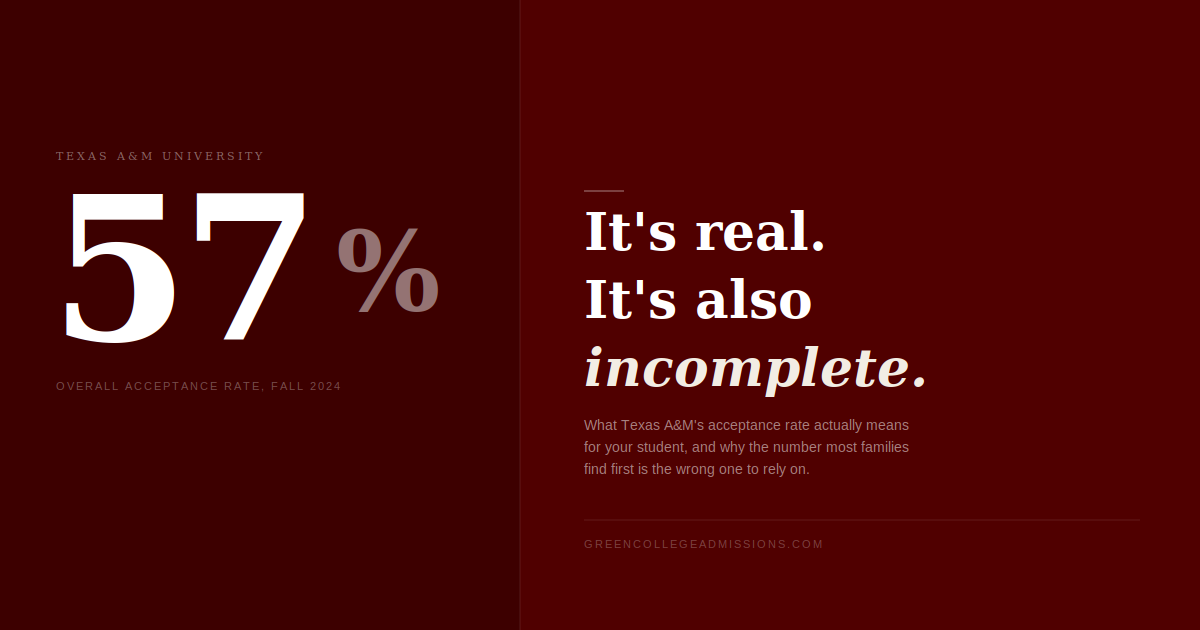
Texas A&M's Acceptance Rate Is 57%. Here's Why That Number Is Misleading.
Texas A&M's 57% acceptance rate is real. It's also incomplete. Here's what the number doesn't tell you about how admissions actually works.
Every spring, thousands of Texas families google the same question: What are my student's chances of getting into Texas A&M?
The answer they find, 57%, sounds reassuring. More than half of applicants get in. Not bad, right?
Not so fast.
The Number Is Real. The Story Behind It Isn't That Simple.
Texas A&M received 54,905 applications for the Class of 2028. Of those, 31,472 were admitted. That math does produce a 57% acceptance rate, sourced directly from the university's own Common Data Set.
But that number is shaped by something most families don't factor in: automatic admission.
Texas law guarantees admission to any Texas public university for students who graduate in the top 10% of their high school class, provided they meet basic coursework requirements. At A&M, auto-admits make up more than 40% of the enrolled freshman class. They're counted in that 57% figure, and they pull the overall rate up significantly.
Here's what that means in plain terms: if your student is in the top 10% of their class, their path to A&M looks very different from a student who isn't. The headline acceptance rate reflects both groups combined. It doesn't separate them.
So What's the Real Number for Everyone Else?
For students going through holistic review, which includes most out-of-state applicants, international students, and in-state students outside the top 10%, the effective acceptance rate is estimated at 25% to 35%.
That's not a minor difference. That's the difference between a school that feels like a solid target and one that requires a real strategy.
Holistic review at A&M considers rigor of coursework, class rank, GPA, essays, and extracurricular involvement. Test scores are considered but not required. There's no formula. Admissions readers are evaluating the whole picture, and the competition in this pool is significant.
Where You Live Changes Your Odds
Geography matters more than most families realize.
In-state applicants: ~59% acceptance rate
Out-of-state applicants: ~49% acceptance rate
That 10-point gap exists because A&M's mission as a Texas public university naturally prioritizes Texas residents, and because auto-admission only applies to Texas high school graduates. Out-of-state students have no guaranteed pathway. Every one of them goes through holistic review.
If you're a Texas family, that's an advantage worth understanding. If you're applying from outside Texas, plan accordingly.
The Number That Actually Tells the Story
Application volume at Texas A&M has grown 34% over the past five years. The university accepted a similar number of students as it did five years ago. The pool just got significantly larger.
What that means: A&M isn't getting harder to get into because they're accepting fewer students. It's getting harder because more competitive students are applying.
The 57% will likely continue to drift lower, not because A&M changed, but because the applicant pool keeps growing.
What's Coming Next
Texas A&M is expected to release admissions data for the 2025-2026 cycle later this year. When that data drops, it will reflect applications submitted in fall 2025, the most competitive pool in school history. We'll cover it here and on Instagram the moment it's available.
The Bottom Line
The 57% acceptance rate isn't wrong; it's just incomplete. For families trying to build a real strategy around Texas A&M, the more useful questions are: Is my student an auto-admit? If not, how does their profile stack up in holistic review? And is A&M a target school, a reach, or something in between?
Those answers look different for every student. If you want to talk through where your student stands, schedule a free consultation.
Data sourced from the Texas A&M Common Data Set 2024-2025, published by the Office of Academic and Business Performance Analytics (ABPA).
Joe Green is an independent college admissions consultant and owner of Green College Admissions, based in Keller, TX. He works with students across the DFW area and nationwide to help them build thoughtful, strategic applications to competitive universities. Learn more at greencollegeadmissions.com.